|
Click here to see this email on the web |
 |
|
Tuesday, January 20th, 2026 |
|
The Silence of Winter |
|
By Christopher Volpe |
|
Share this article:     |
 |
|
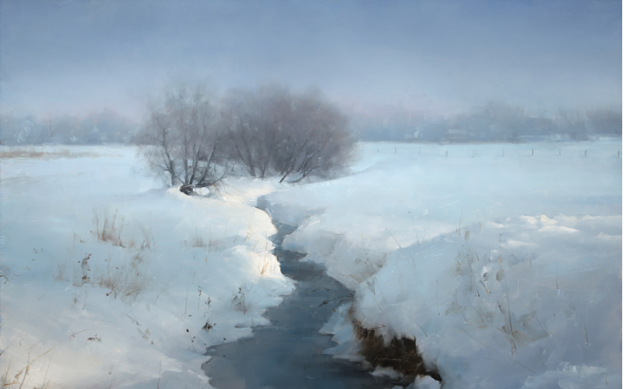
Dave Santillanes, “The Silence of Winter,” oil on canvas, 24 x 38 in. |
|
“Snow reveals color much better than other objects”
— Dave Santillanes
If we are willing to sit with it for a minute and meet it with something of our own memories and imaginings, the painting titled “The Silence of Winter” by Dave Santillanes (above) radiates a sense of slowness and calm.
Go ahead and stop reading and look at it, let it sink in, let it speak. Stillness, silence. Being willing to “slow look” and feel what a painting is doing is like being a good listener. Now, because this is Inside Art, of course we’ll wreck all that by trying to understand why and how this painting achieves that effect. This on the theory that carefully looking at and “listening to” exemplary paintings teaches us how to do it.
First off, our gaze is directed by the perspectival “arrow” of the narrowing foreground stream toward the trees in the middle ground. From there the eye trails off into the atmosphere, where the background forms dissolve, blended into faintly glowing air. The softness and closeness in value provide a visual equivalent of the “silence” in the title.
However, in the masterful interplay of light and shadow in Santillanes’ more dramatic foreground, we may experience a deepening of that silence. It’s when we stand still for a minute and notice something like that – the near-motionless flow of light in nature – that we feel the sense of time suspended. It’s then we can stop and breathe in the stillness and marvel at the silence we so rarely meet elsewhere.
|
 |
|
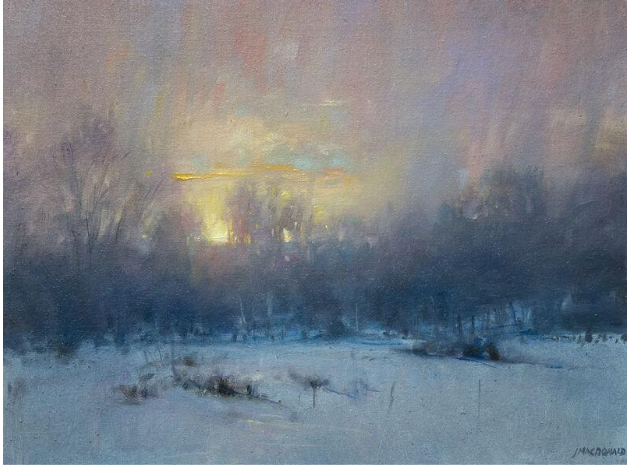
John MacDonald, “Sunset Flurries,” oil on panel, 12 x 16 in.
|
|
A painting like John MacDonald’s “Sunset Flurries” (above) though different in mood, similarly touches into shared memories of solitude in nature. Solitude doesn’t mean loneliness or isolation from others; it refers to the ability to enjoy one’s own company, to be alone and at peace with oneself in unhurried relation to the world and everything in it. Said Jane Goodall, “For those who have experienced the joy of being alone with nature there is really little need to say more; for those who have not, no words of mine can ever describe the powerful, almost mystical knowledge of beauty and eternity that come, suddenly, and all unexpected.”
|
|
— advertisement — |
 |
 |
|
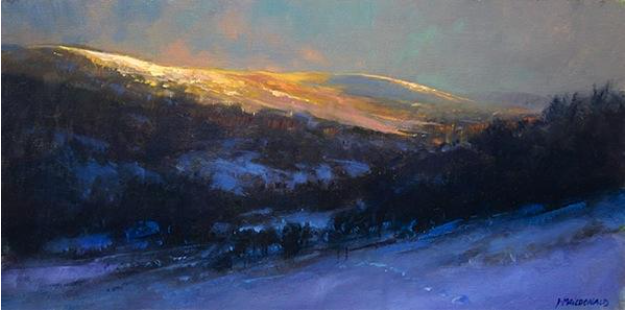
John MacDonald, oil on canvas.
|
|
Sudden awareness of the thunderous beauty of the natural world “gets us out of our heads,” shakes us free of the mind-clutter, the endless thought-loops concerning whatever’s happened or needs to happen next. The Buddhists call it “monkey mind,” and it’s the enemy of thoughtful artists everywhere.
Moments of quiet self-sufficiency remind us that time exists for us only as past memories and future fantasies, which are just thoughts in your head. Nature insists that beyond the mind-made story of unhappy “me,” there’s a deeper level of awareness in which you are pure presence, alert and free from unhappiness, fear, or wishes to be or do anything else.
“Nature ever wears the color of the spirit,” Ralph Waldo Emerson writes. Silence in a snowy field teaches us lessons deeper than any philosophy and farther than any political commentary could ever reach.
“Watch an animal, a flower, a tree, and see how it rests in Being. It is itself,” writes Eckhart Tolle. “It has enormous dignity, innocence, and holiness.
However, for you to see that, you need to go beyond the mental habit of naming and labeling. The moment you look beyond mental labels, you feel that ineffable dimension of nature that cannot be understood by thought or perceived through the senses. It is a harmony, a sacredness that permeates not only the whole of nature but is also within you.”
Dave Santillanes and John MacDonald cover snow-painting in their videos, “Winter Landscapes” and “Poetic Landscapes”, respectively.
Why I’m Drawn to Watercolor
|
 |
|
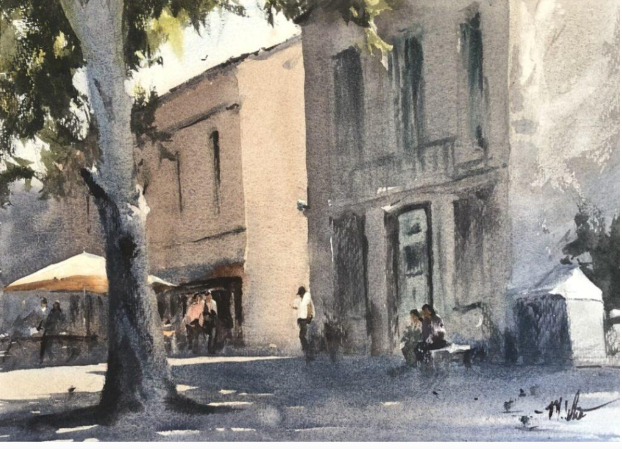
Matthew White, “Hot Afternoon,” watercolor on paper, 11 x 15 in., Available; featured at RealismToday.com
|
|
“Creating art is a powerful experience; it’s a profound way to process, celebrate, and appreciate the world around us,” says Matthew White.
“I was drawn to watercolor for its loose effect, the softness created by the intermingling colors on the paper, and the unique light-to-dark method of painting it requires. Watercolor doesn’t allow you to obsess over a particular painting too long; it presses you forward – onto the next – and it’s invigorating to surrender to its steady, persistent flow.”
Matthew’s work has been featured in exhibits in Italy, China, and Spain. This month, learn from Matthew during the 6th Annual Watercolor Live online art conference, taking place January 21-23, with an Essential Techniques Day on January 20. Register now at https://watercolorlive.com/wcl2026.
|
|
|
|
|
— advertisement — |
 |
|
|
|
|
|
Inside Art is committed to protecting and respecting your privacy. We do not rent or share your email address. By submitting your email address, you consent to Streamline Publishing delivering regular email issues and advertisements. To end your Inside Art e-mail subscription and associated external offers, unsubscribe here. To learn more about Streamline Publishing events, products, and offerings visit StreamlinePublishing.com
Copyright 2024 Streamline Publishing, Inc. All rights reserved.
Inside Art® is a registered trademark of Streamline Publishing, Inc. |
|
|
|
|